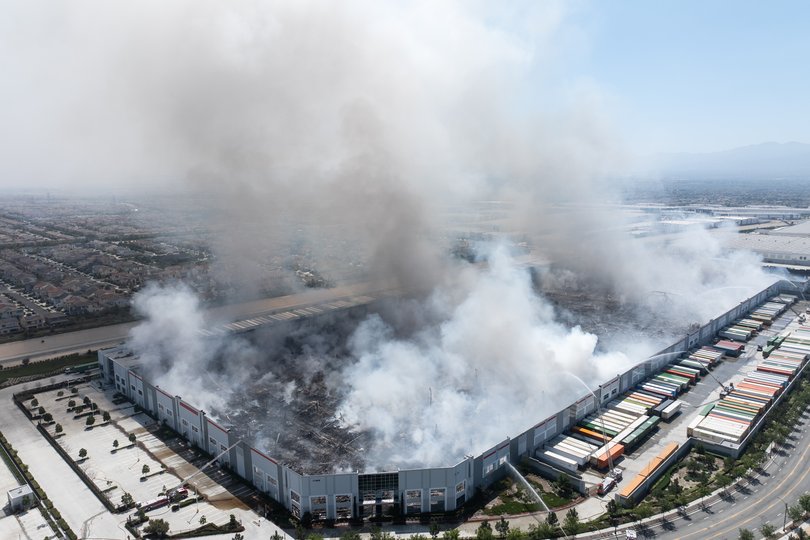
An Ontario warehouse leased by “personal care and hygiene giant” Kimberly-Clark was set ablaze on April 7. At first, it appeared to be an act done in the spirit of protest against mega-corporations’ failure to pay their employees fair wages. However, committing arson or any violent crime should not be a normalized form of protest, as it endangers innocents’ lives and sullies the reputation of peaceful protests.
While this controversial act has caught the media’s eye and raised awareness of the mistreatment of warehouse workers, there are safer alternatives to protesting, including but not limited to strikes, walkouts, marches and boycotting. These can all lead to a loss of revenue for large corporations, demonstrating the need for their workers’ satisfaction to be met while still maintaining a sense of adherence to the law.
In an online video circulating on the internet, a man — suspected to be Chamel Abdulkarim, 29, of Highland, CA — is seen walking around the warehouse, lighting several toilet-paper products on fire, and is heard saying, “All you had to do is pay us enough to live.” Abdulkarim has been arrested on suspicion of connection with the fire and is currently facing several arson-related charges.
While the Ontario warehouse was leased by Kimberly-Clark, Abdulkarim was hired by National Freight, Inc. (NFI Industries) which operated the warehouse. Reports allege that the average yearly salary for an NFI Industries Warehouse Operations worker in Ontario is “$58,370, which is 11% below the national average,” explaining Abdulkarim’s statement regarding the low pay employees received.
Low pay should not constitute violent offenses, such as arson in this case, but since the crime has already been committed, the media should focus on shedding light on the lack of accountability from big corporations for not providing fair, livable wages to their employees.
Kimberly-Clark is a multi-billion-dollar corporation that can afford to pay its employees fairly, but when an employee resorts to setting an entire warehouse on fire to bring attention to this issue, the public must band together to hold big corporations accountable for their actions, lest violence becomes more likely.
For example, in 2024, the world bore witness to the discourse of the Luigi Mangione case, where Mangione was accused of being responsible for the “murder of 50-year-old United Healthcare CEO Brian Thompson outside of the Hilton Hotel in Midtown on December 4, 2024,” in response to “corporate greed.” While Magione’s case has blown up in popularity due to its vigilante-like nature, he has not officially been found guilty of the allegations.
Following Thompson’s death, public discourse immediately ensued, where the people either condemned the violent act or resonated with his frustration about the corrupt medical system found in the U.S. today. Health care is oftentimes treated as a business transaction — led by insurance companies — rather than a basic human right.
If big corporations do not take accountability for the mistreatment and underappreciation of their employees, more cases similar to Mangione’s are likely to arise. As “Cabaret (The Musical)” states, “Money makes the world go round,” and without sufficient pay, people are unable to afford basic human needs, including housing, food and healthcare.
Additionally, referring back to the video of the suspect lighting the warehouse fire, the narrator states, “You know, if you’re not going to pay us enough … to afford to live, at least pay us enough not to do this.” The audience gets a glimpse into the perpetrator’s mind, where he believes that the company Kimberly-Clark is responsible for forcing him to resort to violence as a cry for help, rather than pure malice.
Again, while the perpetrator’s actions should be condemned, his sentiment of advocating for better pay is reminiscent of many local labor unions’ efforts, including Teamsters Local 1932. The Teamsters are a “labor union transforming the Inland Empire for the underpaid and overworked” and one of their core goals is to improve employees’ wages, working conditions and benefits through collective bargaining.
It’s been theorized that, “If Amazon recognized the Teamsters’ new union and bargained in good faith with them, we would likely see a much smoother, undisrupted holiday shopping season in 2025.” The power of collective action can lead to positive results for all involved, including better working conditions for employees and for consumers receiving better services.
Moving forward, big corporations must be held accountable for their underappreciation of employees. It is not only in their workers’ best interests to be treated well by these companies, but also the corporations’ best interests. If big corporations were more willing to provide their employees with better working conditions and pay, violent offenses reminiscent of the warehouse fire and the Luigi Mangione case are less likely to occur, and, bluntly put, these companies can afford to pay their employees better.
Corporate greed harms all in the process, and it must be addressed now, not later.