The 2026 Tomás Rivera Conference was a celebration of storytelling, specifically in cinema. As a Chicano literary storyteller, Tomás Rivera made way for many others to follow in his footsteps. The conference featured Severo Perez and Luiz Valdez, two influential Chicano filmmakers, who implored the audience to keep storytelling alive.
Tomás Rivera was the first Mexican chancellor in the University of California system,
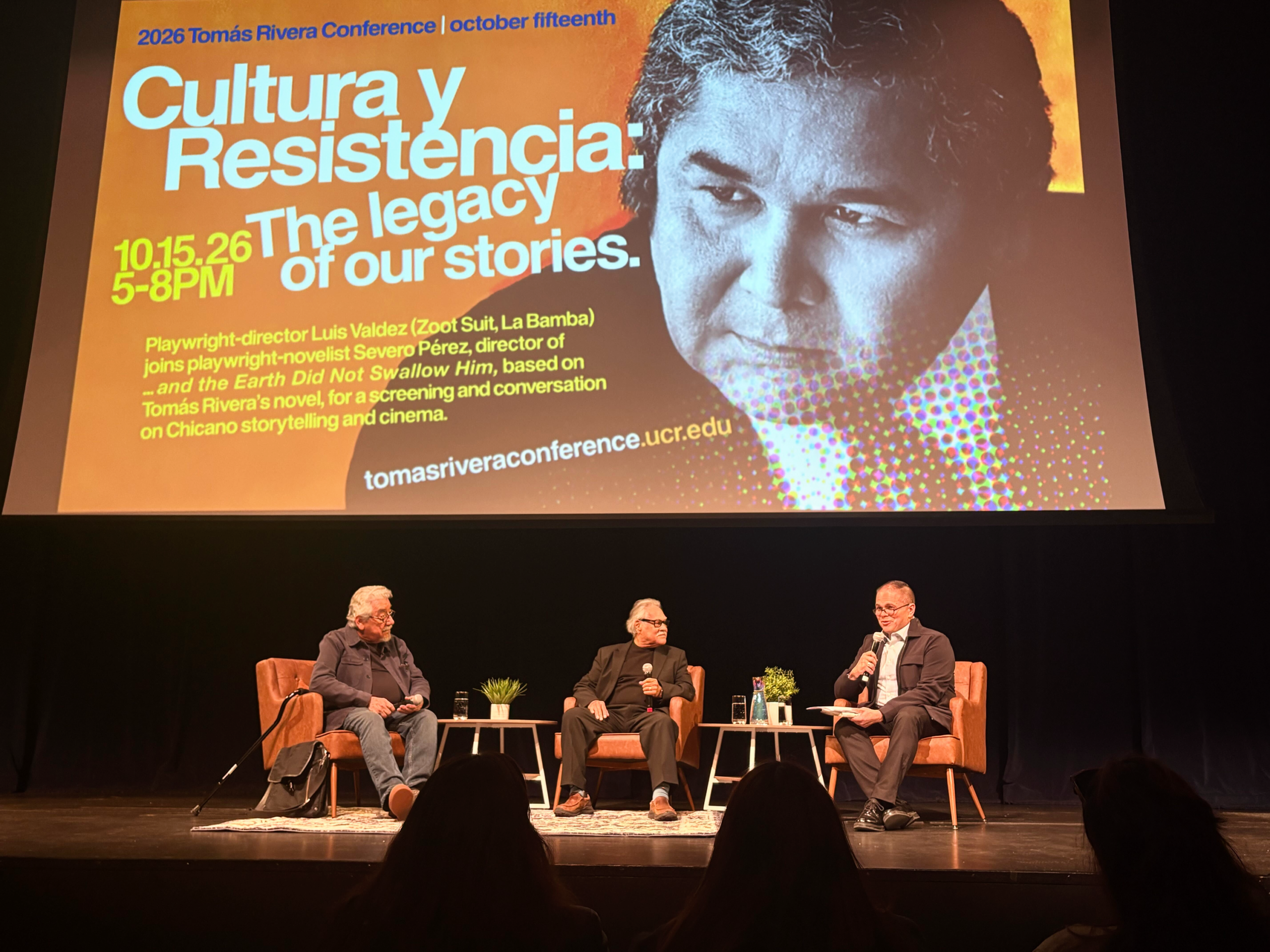
holding the position up until his death in 1984. Since 1988, the University of California (UCR) has held an annual Tomás Rivera conference in his honor. On Oct. 15, 2026, the Tomás Rivera conference Cultura y Resistencia: The Legacy of our Stories was held in the University Theatre.
Luiz Valdez is the director behind films such as “La Bamba” and “Zoot Suit.” Both films include themes of struggles faced within the Chicano community. Severo Perez is well known for his film “…And the Earth Did Not Swallow Him” which is an adaptation of the novel “…y no se lo trago la tierra” by Tomás Rivera.
The conference opened with a welcome from CHASS Interim Dean, Steven Helfand and was followed by a Tomás Rivera Tribute from Alex Espinoza, The Tomás Rivera Endowed Chair. Afterwards, there was an acknowledgement of the work Concha Rivera, Tomás Rivera’s wife, had done to make the conference possible. Before Valdez and Severo were presented, Estella Acuña presented the Tomás and Concha Rivera scholarships to seven students.
Luiz Valdez and Severo Perez then had the opportunity to sit down and talk with Dr. Richard T. Rodriguez to answer inquiries about film and cinema in regards to the Chicano experience.
The Q&A session was followed by the screening of Severo Perez’s “…And the Earth Did Not Swallow Him.” Perez, after having read Tomás Rivera’s novella, immediately “saw the film I wanted to make” as he was “moved by the fact that it spoke in the language that I grew up with, the syntax, the phrasing [and] the words were of a culture that felt very familiar to me.”
The film offers a painful account of systemic injustices and hardships that Mexican-American communities faced in the mid-20th century through the lens of a 12-year old boy Marcos (Jose Alcala). The film carries a surreal, contemplative atmosphere as mirroring the book’s unconventional structure, the film is told in fragments. This imbues a sense that the audience is exploring the interiority and the memories of Marcos. The theme surrounding the disillusionment of religion further heightens this quality as the daily struggles Marcos finds himself in overweighs the spirituality.
Similar to the communities it depicts, Chicano cinema itself has been facing significant oppression, particularly from mainstream Hollywood as they limit the opportunities and creative control while simultaneously exploiting it. “I put the deal together at Universal Studios that got Zoot Suit made, and the reason that Luis [Valdez] could not get a deal to produce the film before was because they kept telling, ‘well why don’t we put John Travolta as the main character?’ and Luis was saying ‘thats against what I want to do.’ So the deal I put together was that he could choose the cast, he would direct [and] he would write but the budget would be low. But what happened was that it made a lot of money for them, but they still didn’t get the idea that they should make more films like that. They did try to do more Latino films, but it was certainly not something for a Chicano audience. In fact, it didn’t reach American audiences either.”
Perez emphasized that the issue has to be combatted “by numbers. There’s only one Spielberg, and at least 5,000 other people trying to be a Steven Spielberg, and some of them are just as good and even better, but he got the name, he got the place, he had the timing and all those kinds of things. So it comes down to numbers and desires.”
Luiz Valdez and Severo Perez are both filmmakers who have helped Chicano stories be shared with others who are not part of the community. Through their ability to direct and write the struggles, hardships and emotions felt by Chicanos, they are able to emphasize how important it is to share one’s own stories with others. As Valdez stated during the Q&A, “Every culture, every community, every generation needs good storytellers and not just in film, but in music too tell me a story and give it to me because I want to know where I am.” Storytelling keeps culture alive by retelling traditions and cultural customs. Films help people see themselves represented in places where they are usually not welcome. Music allows everyone to audibly enjoy any story that the storyteller chooses to share.