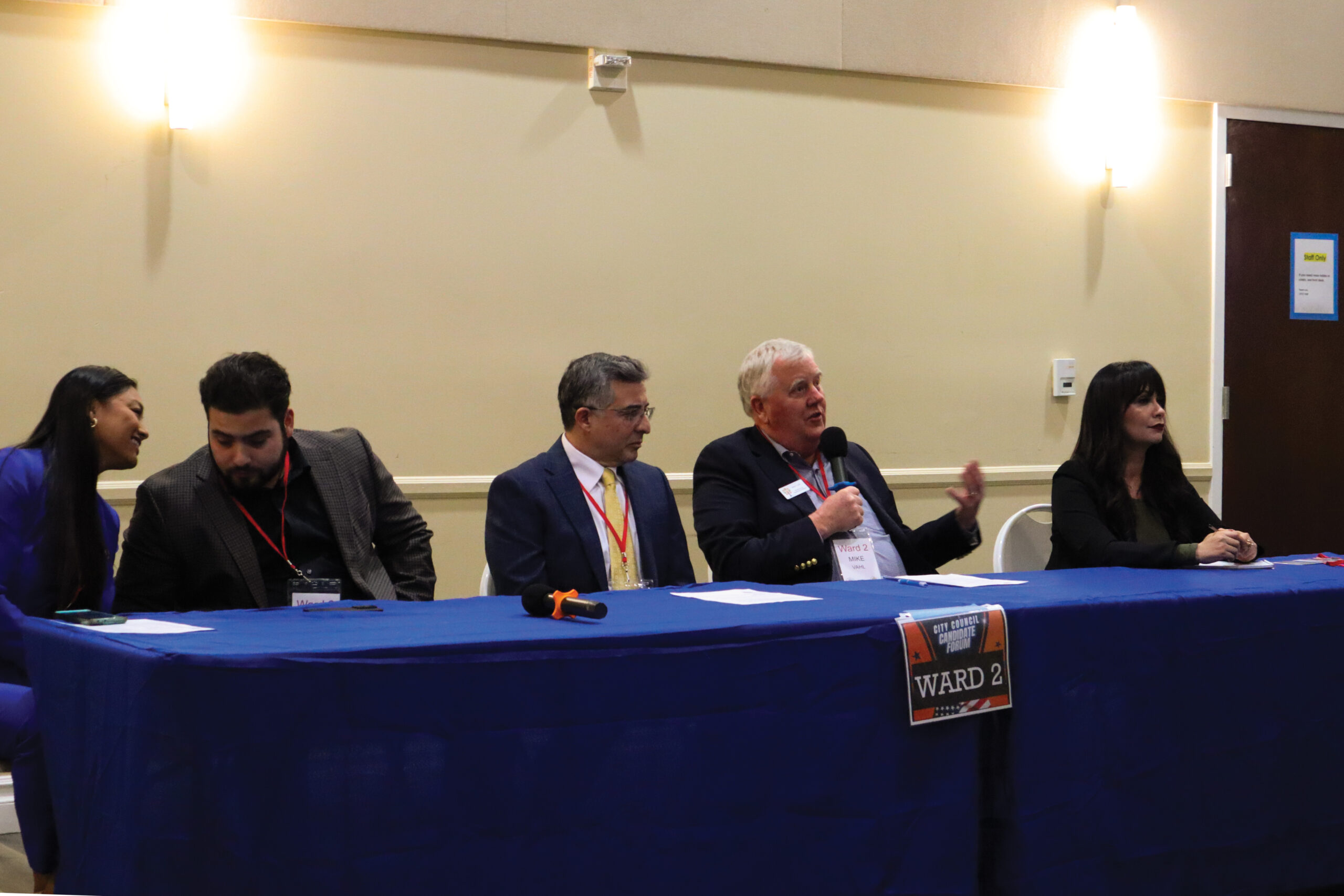
With elections for councilmember positions coming up for Riverside’s wards two, four and six in June, 11 candidates began their campaigns during an open forum at the Orange Terrace Community Center on Jan. 9. Hosted by the Mission Grove Neighborhood Association (MGNA), candidates from the three electing wards were asked to deliver opening statements, respond to two pre-assigned questions along with one question from the audience and deliver concluding statements.
The eleven participating candidates included Aram Ayra, Christen Montero, Gracie Torres, Mike Vahl and Dan Florez for ward two which covers the area of University Neighborhood, Hunter Park, Canyon Crest and Sycamore. Chuck Condor, Jessica Qattawi and Rich Vandenberg, from ward four covers Alessandro Heights, Mission Grove, Orangecrest and Greenbelt. Luis Hernandez, Ozwaldo Puerta and William Smith from ward six which covers Arlanza, La Sierra, La Sierra Hills, La Sierra South and parts of Arlington.
All candidates are registered as non-partisan, excluding Montero, Vahl, Vandenberg and Florez, whose political affiliation could not be verified.
The first question posed to candidates how they planned on managing Riverside’s “growth vs. character dilemma,” referring to the city’s struggle to “navigate state housing mandates (RHNA) that strip local control over parking and environmental standards while managing the surge in warehouse and high-density development.”
Although candidates from all wards generally agreed on the importance of following through with RHNA guidelines to avoid increased state intervention and a disapproval of the presence of warehouses, they presented differing resolutions.
Torres, Montero, Ayra, Qattawi, Hernandez and Puerta referenced the limitations state regulations impose on city development and said that they would seek to mitigate its effects. Torres and Puerta by stating they would adhere to the city’s general planning, zoning rules and pre-existing toolkits to meet state requirements.
Montero expressed she would look to invite in “forward career” development.Ayra, Qattawi and Hernandez suggested they would invite new industry on the condition it improves residents quality of living and push back against RHNA mandates that exceed the city’s available resources.
Vandenberg and Smith emphasized the importance of not allowing RHNA mandates to stress the local economy and government.
Vahl, Conder and Florez emphasized a need to combat the state’s RHNA mandates. Vahl vocalized his intent to push back against impractical businesses such as “big pharma” and in response to RHNA mandates, leverage the city’s position as a charter city and preexisting high density of warehouses to lower state demand.
Flores stated that although the presence of warehouses in the city is not something he could combat, a sentiment shared by Conder, who stated that “the state government is overwhelming local control, we cannot give up control even though I understand there are penalties for us if we don’t,” and called for citizens to form coalitions against the RHNA mandates.
The second question asked for candidates’ opinions on “the public trust gap,” where they were asked if they believed the city had successfully upheld standards set for communal engagement in their Citywide Community Engagement Policy, which was adopted in 2023 and mandates councilmembers engage in good transparency tactics and consideration to residents.
All candidates, with the exception of the only incumbent candidate Condor agreed that the community engagement policy had not been sufficiently adhered to. Grievances with the sitting councilmember’s practices were raised by some candidates who cited the practice of the council cutting speaking time at meetings from the allocated three minutes, such as Hernandez, who stated “if you don’t want to spend the night there when there’s something important that people want to talk about, don’t run for city council,” among others.
For the final portion of the form, the MGNA pulled from question cards they had handed out to the audience before the form began. In response to a large request for a response to the issue, they asked candidates to respond to how they would have voted on the rejected proposal for an affordable housing project on University Ave., which had been voted on the day before.
Conder, who had been in the prevailing vote during the meeting, expressed that he had chosen to vote against the measure as he believed “it was rushed through by a certain individual trying to make it as a campaign piece for her going to Sacramento.” Vahl, Puerta and Florez also stated that they would have voted against the project. Citing uncertainties in its effectiveness and lack of accompanying services.
Ayra, Montero, Qattawi, Vandenberg, Hernandez and Smith stated they would have voted in favor of the project due to its potential to aid the community, among other factors.
Torres opted to not vote, stating that she couldn’t without proper community engagement.
The second form is set to take place on Jan. 21 at the La Sierra Senior Center and is open to the public.