
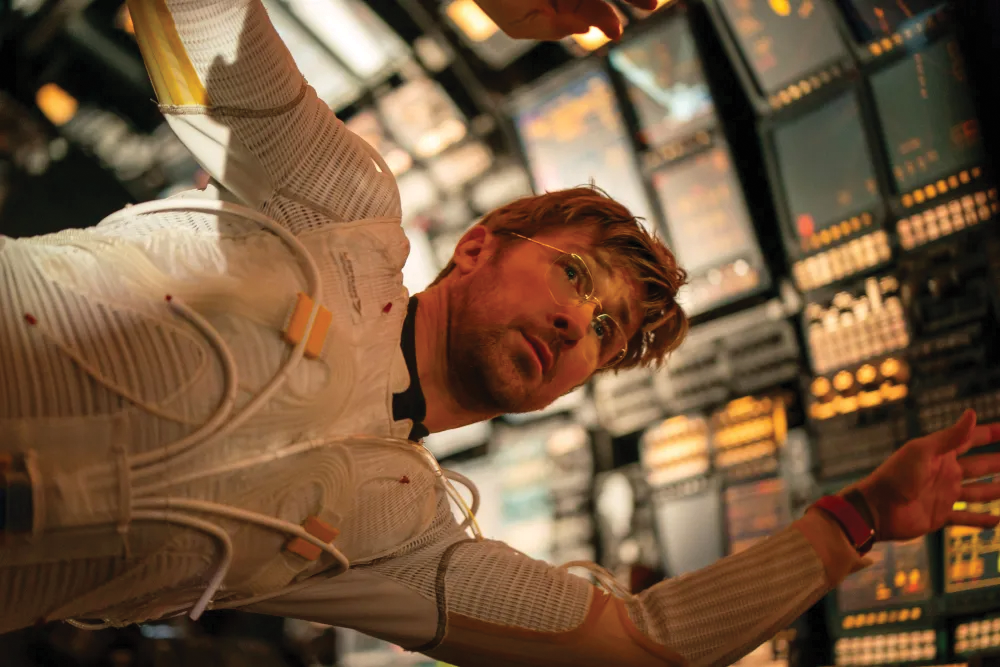
Most of the time, dystopian science fiction tends to be fairly bleak. This makes sense, as layering hypothetical threats on top of the already messy modern world would normally only serve to craft a cautionary tale, but “Project Hail Mary”’s optimistic tone proves this genre’s true range. Like “The Martian,” this is yet another near-future hard sci-fi film about a man stranded alone in space based on a novel by Andy Weir, yet it remains refreshing through an absurd quantity of other strengths. The end result is a fun and enjoyable movie that manages to uphold its prestige through technical achievement.
The basic concept of the story, despite the layers of carefully researched scientific explanation embedded in the source material, is quite simple: The sun is dying and Dr. Ryland Grace, portrayed by beloved actor Ryan Gosling, must travel to another star to figure out how to save it. After overcoming a nearly insurmountable language barrier, he is eventually aided by an alien engineer named Rocky, and the two of them turn the narrative into a feel-good buddy picture about saving the universe.
Lots of weight was placed on Gosling, considering how much of the runtime is dedicated to Dr. Grace problem-solving either alone or alongside the puppet Rocky, but luckily the performance delivers and then some. Even in the absence of other actors to play off of, he radiates with charisma and heart, and his comedic energy carefully gives emotional moments time to breathe while still lifting the otherwise heavier content tonally. Weir, Gosling and screenwriter Drew Goddard have come together to develop a protagonist that keeps feelings high, scenes engaging and science cool.
The level of thought behind every fictional concept in both the novel and this adaptation is astounding. Something as simple as Rocky’s inability to see is expanded to such an intriguing degree. Since his people do not perceive light, they likely never would have researched it very deeply, leaving them without any understanding of concepts like wave-particle duality. Without a discovery like this, they are shown to also have no understanding of crucial scientific concepts like radiation and relativity, which ends up causing disastrous consequences later on. Attention to detail is one thing, but “Project Hail Mary” takes this a step further by tying these ideas back into the story itself. Hopefully, despite his flaws, Ryland Grace becomes an inspiration for the next generation of moviegoers to learn more about how the world around them works, making science interesting again in the same way “Interstellar” did.
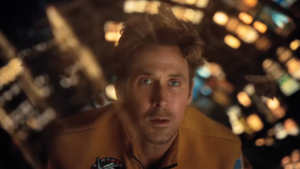
One might be skeptical about how directors Phil Lord and Chris Miller would portray Grace and Rocky’s relationship. Despite poor marketing to the contrary, this film is free of any overly obnoxious “Marvel dialogue” tropes. Rocky’s limited English vocabulary and Grace’s struggle to step into the role of a hero keep any conversation from turning into quippy banter. Instead, their bond feels authentic for two individuals confronted with such literally cosmic loneliness and their dialogue is understandably witty given their demonstrated intelligence. Lord and Miller’s streak remains unbroken with yet another project of endless appeal.
Fans of the original 2021 novel will be quite happy with this film as an adaptation too. Weir was brought on as a producer, and his influence is evident in every detail of the worldbuilding. While many omissions were made, none stand out as particularly egregious. This adaptation manages to keep its pacing in check while still bringing the entire heart of the pages to the big screen.
“Project Hail Mary” takes advantage of its medium in more ways than just an intricate and condensed script, but also through gorgeous cinematography. Edits of the climactic and already iconic cloud-fishing scene set to Harry Styles’ “Sign of the Times” have become inescapable on social media, and for good reason. The scene is spectacular, and due to another earlier scene in the film, the song has successfully become synonymous with the project itself.
Verdict: Greig Fraser’s artistry behind the camera brings space to life as wondrous, vast and incomprehensibly beautiful, transforming the movie from a must-see to a must-see-in-theaters. Most importantly, this film is simply a great time for anyone who enjoys clever science fiction, engaging character dynamics, high-stakes drama or comedy.