
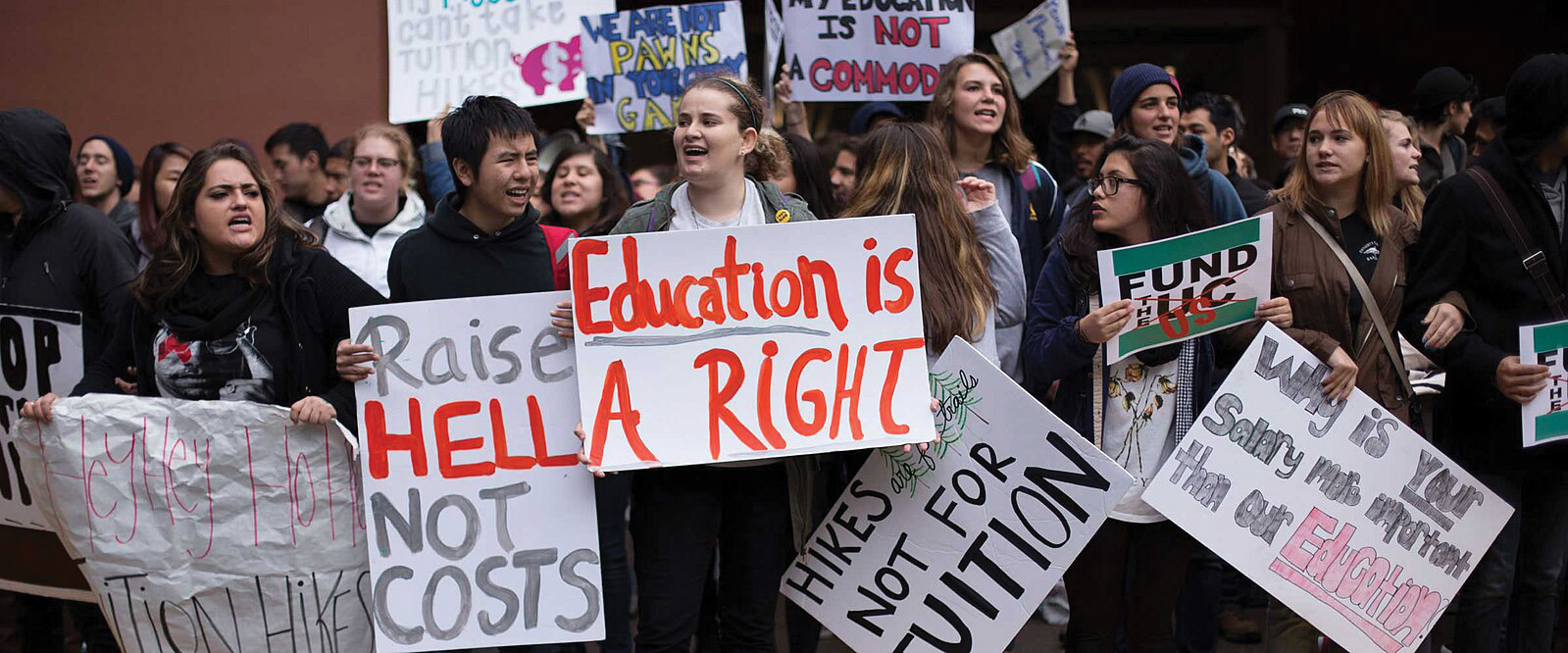
On Nov. 19, 2025, the University of California (UC) Board of Regents approved an undergraduate tuition increase for future students despite systemwide student opposition.
In a 13-3 vote, the Board renewed its Tuition Stability Plan — first adopted under former UC President Michael V. Drake in 2021 — that includes several amendments set to take effect in the 2026-27 academic year.
Under the Tuition Stability Plan, regents can approve undergraduate tuition and systemwide fee increases up to five percent annually. Each cohort of students pays a fixed tuition rate for up to six years, with every new class paying more than the last and less than the next cohort. However, graduate students are exempt from this model and instead receive annual tuition increases tied to inflation.
The UC Regents’ renewed version adds three amendments to the Tuition Stability Plan.
First, while regents can still raise tuition by up to five percent each year, they can now “bank” any amount over the cap for future years. This means if the regents approve a tuition hike greater than five percent due to inflation but can only charge students a five percent increase that year, the extra percentage can be “banked” and applied to a future year to help offset or reduce future tuition hikes. This approach was created in 2022 to create long-term “stability” after the 2007 Great Recession, when UC tuition doubled in six years.
Second, the UC will lower the return-to-aid rate — the percentage of tuition increase that must be allocated to financial aid — from 45 to 40%, with the eventual goal of returning to the pre-Tuition Stability Plan rate of 33%.

Finally, future student tuition and fee increases will be based on that year’s inflation plus an additional one percent increase for capital improvements, such as campus infrastructure and facilities.
The renewed plan comes at a time of significant funding challenges for the university. At the meeting, UC President James B. Milliken reported that the system had laid off 800 employees this year, which he said was “extraordinarily difficult” and “implemented only as a last resort.” The UC’s budget crisis, he warned, is “serious and compounding.”
However, students from across the UC system and the UC Student Association (UCSA) — the systemwide coalition representing undergraduate students from all UC campuses — gathered at the meeting to protest the tuition hike.
“Future generations of students should not be subject to these forever hikes while non-tuition costs continue to exacerbate inequities and higher education remains inaccessible to so many,” UCSA said in a statement.
Two things can be true at once: yes, the UC needs to increase tuition to keep pace with inflation, maintain adequate student services and continue enrolling more in-state students as required by the state legislature. However, the burden of federal and state funding cuts should not fall on students and their families — many of whom are already struggling with the rising cost of living.
The UC prides itself on fostering access to higher education and socioeconomic mobility. In 2025, 41.8% of admitted first-year students were low-income and 42.4% were first-generation. As the #1 university in the nation for social mobility, UC Riverside serves a student body that is 58% first-generation, with 87% of undergraduates receiving financial aid. However, these tuition hikes and the shrinking return-to-aid rate directly threaten the system’s ability to support these very students.
Other groups are already feeling the strain of paying for tuition or facing barriers to financial aid. Last year, the regents approved a $3,402 tuition hike for incoming out-of-state and international students. This month, the Trump administration sued California over laws that allow the state’s undocumented students to pay in-state tuition at public universities and receive scholarships and student loans.
Middle-income students and families, in particular, may face the worst of the renewed plan as they earn too much to qualify for most of the substantive financial aid programs but too little to absorb thousands of dollars in new tuition costs without going into debt.
If tuition continues to rise while financial aid declines, fewer students from most socioeconomic backgrounds will be able to attend a UC campus or will incur debilitating student debt. The return-to-aid rate should remain at a percentage that ensures students have access to adequate financial aid and student loans without delays or months of waiting. Access to higher education, especially public higher education, should not depend on a family’s ability to accept crippling debt.
But the real failure here lies with the federal and state governments. Over the past year, The Highlander has reported on the UC hiring freeze, federal threats to Diversity, Equity and Inclusion (DEI) funding, President Trump’s cuts to National Institutes of Health (NIH) funding and the state’s initial proposal to cut the UC funding despite the UC increasing in-state student enrollment.
Students and families should not be forced into financial instability because government leaders refuse to fund public education. Public higher education is not a privilege; it is a right. The UC leads the nation in public university research and social mobility, which makes the federal government’s politically motivated funding cuts especially unjust. The state must also follow through on its promise to provide full funding to the UC this next budget year, as the UC has enrolled more in-state students over the past few years.
However, given the unprecedented challenges facing public higher education, it is time to consider new policies that protect students and families. For example, California Community Colleges and K-14 schools receive guaranteed state funding through Proposition 98, which establishes an annual minimum funding level every fiscal year for these systems.
As a major economic driver for the state, the UC deserves similar protection. California should pass a constitutional amendment that guarantees funding for the UC, protecting the university system from fluctuations in the state’s general fund and preventing the need for increasingly steep tuition hikes.
The UC cannot continue shifting the financial burden onto students and families simply to fill the funding gap created by state and federal cuts. It is the government’s responsibility to use the taxpayer dollars Californians pay to fund the education of this state’s students.
Future students deserve better and the UC, Sacramento and Washington, D.C. must do better.