
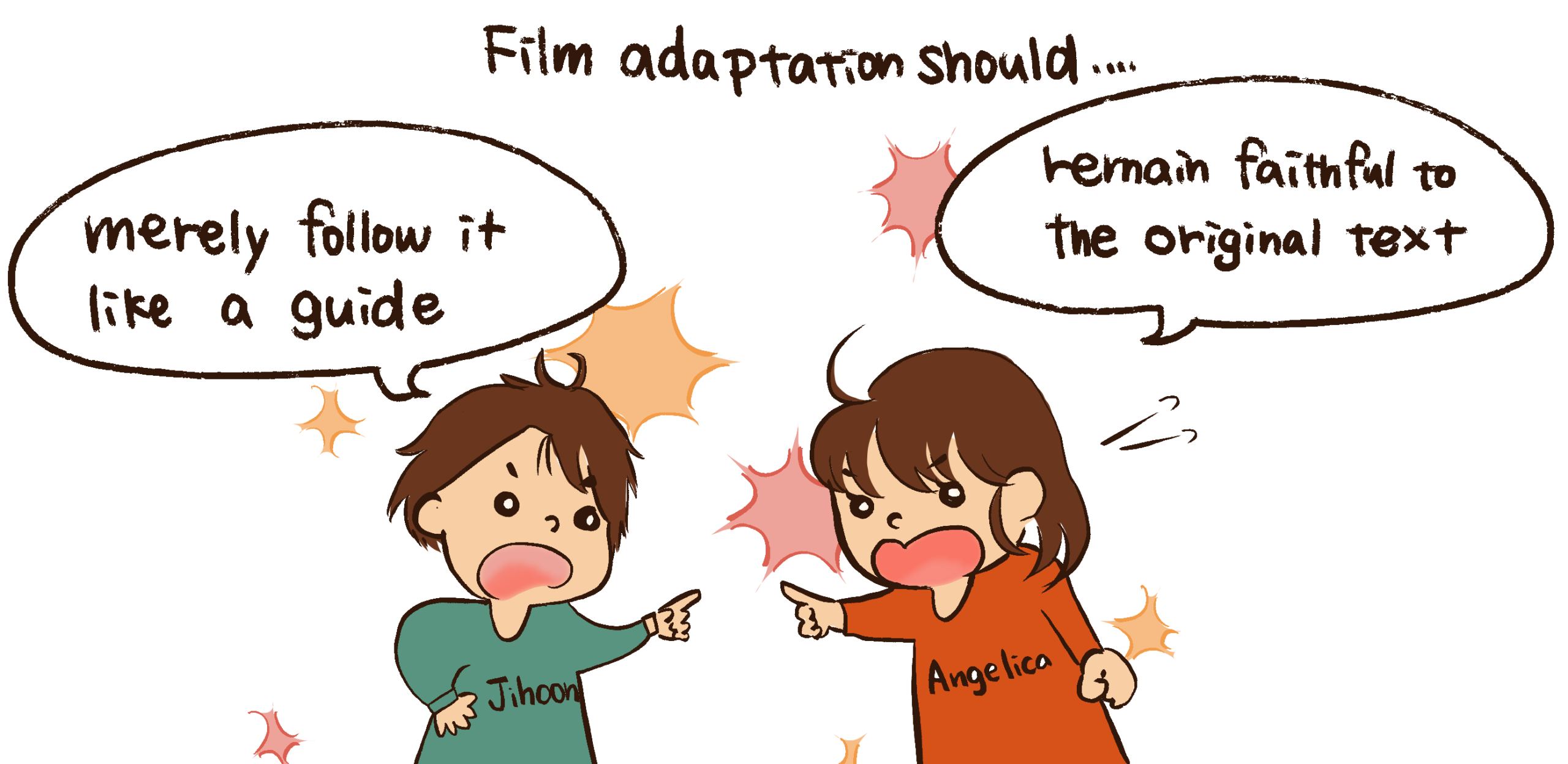
As illustrated in “Adaptation” by Spike Jonze, the idea of a faithful adaptation is a myth, a doctrine that every talented filmmaker wrestles with and eventually abandons. Cinema and literature are inherently two different media, each provoking its own experiences, one through camera and the other through prose.
Cinema carries visual precision and kinetic energy as its essence is a moving image, while literature allows deeper complexity and flexibility through verbal explicitness. Because of this, a direct translation is unattainable and the very act of adaptation already becomes a kind of transformation rather than preservation. To argue that a film adaptation must stay faithful to its source material fundamentally ignores the discrepancy between the art forms.
The point of adaptation becomes reinterpretation from the director’s perspective. A film doesn’t exist in isolation, but rather in conversations with various preexisting texts and ideas as well as the cultural and societal climate surrounding it. Consider the most recent Oscars winner, “One Battle After Another.” Paul Thomas Anderson takes Thomas Pynchon’s “Vineland,” which explores the aftermath of the ‘60s and the death of counterculture, reinventing it into a strikingly contemporary film.
The film is a cultural and political critique of the 2020s under the Trump administration. Through this, Anderson recontextualizes the essence of the original book, shifting the discourse around the film from merely measuring the fidelity of the adaptation to something with greater relevance to the era.

Furthermore, as articulated by François Truffaut in “A Certain Tendency of French Cinema,” pursuing faithfulness is not a particularly meaningful goal and is artistically unambitious and timid. Instead, it argues that a film should be driven entirely by the director’s voice and personality. Many successful adaptations work because of where these films are situated in the director’s filmography.
Greta Gerwig’s “Little Women” is centered around themes of agency and identity of women, filtered through self-awareness similar to her other films. “Frankenstein” saw Guillermo del Toro revisiting his familiar concept of monstrosity juxtaposed with humanity, with a tint of romanticized naivete buried under grotesque melancholy. “No Country for Old Men” explores the absurdity of existence in a deadpan, slightly humorous tone, a formula that the Coen brothers have repeatedly visited throughout their careers.
These films are distinctly a work of the directors, independent from the respective authors Louisa May Alcott, Mary Shelley and Cormac McCarthy. In fact, staying true to the original text often ends up betraying the author. Reinterpretation doesn’t take away from the value of the work itself. Despite Stephen King’s dislike for “The Shining,” it is considered canonical in American cinema.
The notion of a faithful adaptation subjugates the film to its original text, depriving it of necessity and satisfying only the expectations of the ones watching the film because they’ve enjoyed the book and are intrinsically biased towards it. Cinema is a self-sufficient art form with a distinct grammar that doesn’t need to borrow authority from another medium. An adaptation doesn’t exist without the source material, but its merit is valued independently