
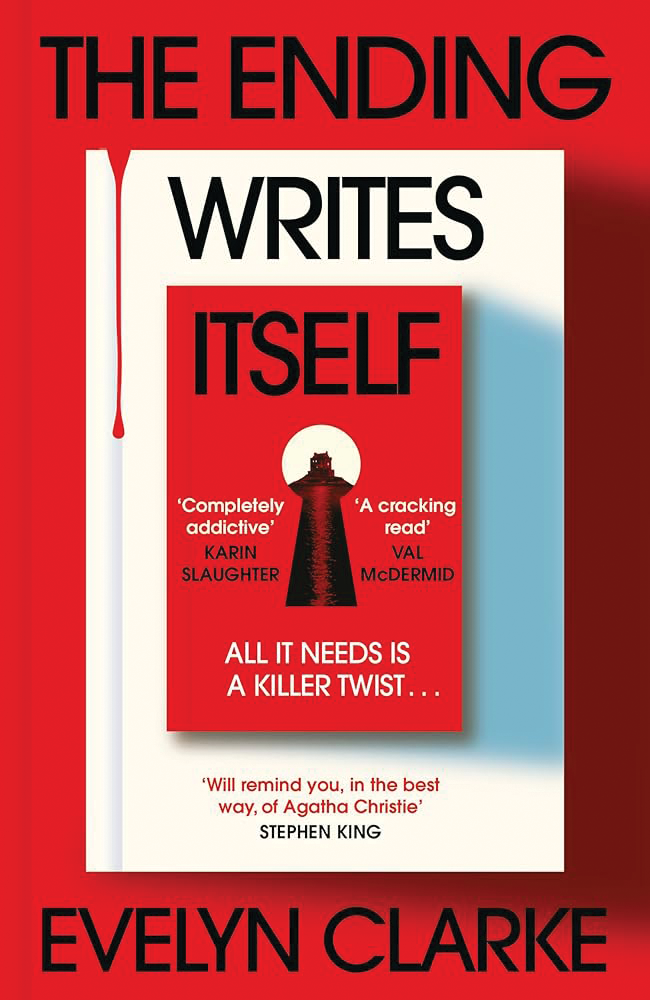
The very title of the mystery novel, “The Ending Writes Itself,” by Evelyn Clarke, begins with a titular mystery: Evelyn Clarke isn’t real. She’s actually two people. The novel is framed as the writer’s debut, but is secretly the work of experienced writing duo Cat Clarke and Victoria Elizabeth “V.E.” Schwab.
The duo has been friends for 15 years and revealed how the novel came about in an interview with National Public Radio host Scott Simon. Clarke, a screenwriter who had left publishing in 2018, co-wrote the book with Schwab — who once vowed to never co-write a novel — in an unlikely partnership. By publishing under the pseudonym of Evelyn Clarke, the duo created distance for themselves, allowing themselves to depersonalize the writer-novel connection and produce a voice that is uniquely Evelyn Clarke, rather than solely Clarke or Schwab.
Six struggling authors — the classic starving artist trope — follow an undeniable exclusive invite for a retreat to a desolate private island in Scotland. When they arrive, the writers instead find themselves with the challenge to write the ending to late literary legend Aurther Fletch’s manuscript with 72 hours on the clock and are locked away in a castle on the island. While not the relaxing spa getaway the writers may have looked forward to, it still seems like an opportunity too good to be true for floundering writers.
Framed as six writers representing the different genres they write personified, among them are romance, horror, science fiction, murder and young adult writers, and a married duo writing thriller novels under a united pen name. Drawing a similarity between the characters and authors of this novel, making for seven people on the island.
The novel, while representing the voices of the two authors united, is split into an even six parts, each part highlighting one of the “six” writers.
As would happen on a private island far away from home with restricted contact to the outside world, what started as a good time on the writers’ 72-hour getaway promptly becomes unpleasant. With seven tired, struggling humans packed onto an island with their future as writers on the hot seat, the ugly and often unseen pains of the publishing world continuously begin to show.
With Clarke and Schwab having frontline experience as authors themselves, there is without a doubt parallels between their own struggles navigating the publishing world versus that of the writers on the island.
The characters are highly unlikeable, and their behavior and dialogues become even more headache-inducing as the novel progresses, but maybe they’re meant to be that way. The struggling authors were never meant to be liked, only to be understood and serve as commentary on the good, the bad and in between in the life of an author.
From the outside looking in, the life of an author may seem nothing short of glamorous. But “The Ending Writes Itself,” in all its Agatha Christie-esque glory, shows that the publishing world is unforgiving and full of vitriolic individuals waiting to drag fellow writers down to get even the hope of an opportunity.
Everything in the book comes back to the lives of its very authors, seeing as Schwab is a published yet struggling author, and Clarke has renounced publishing for the screenwriting industry.
That said, the book progresses slowly at times, and its title doesn’t fully explain itself until its very end. Even then, the authors’ consistent use of ambiguity and love for leaving the reader guessing have left readers with the question of whether the ending was written or made by circumstance.
For a novel intended to be a thriller, the ending is provocative and elusive, and while the underlying murder plot may be a bit too extreme to be realistic, it certainly serves as a scathing commentary on the “killer” realities of authors. Life as a writer is constant life and death — whether dramatized and hyperbolized for the sake of a thriller novel, or experienced in the lives of the two writers behind “The Ending Writes Itself.”
Verdict: An astute, cognizant and masterful satire of — as well as a comforting love letter to — the publishing industry woven with thrilled crime themes, “The Ending Writes Itself” is a strong next pick for one’s to-be-read list this spring.