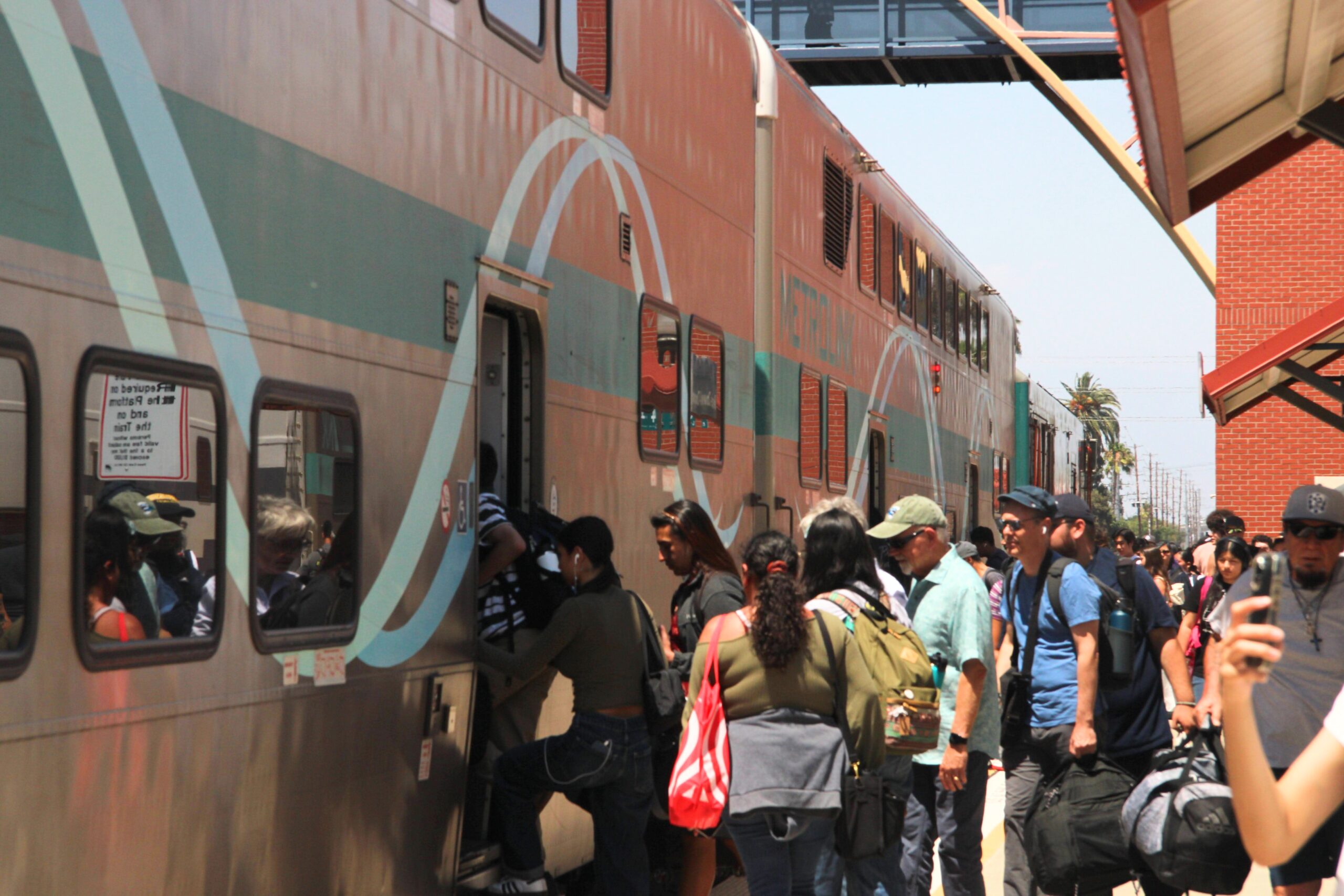
Metrolink, a commuter rail agency serving six counties in Southern California, is cutting rail service. In recent years the agency has been impacted by increasing operational costs, along with reduced fare revenue and county contributions towards its budget. Transit advocates and riders are advocating for full restoration of funding and the Metrolink schedule.
Metrolink has experienced reliability problems concerning their new locomotives, with a March staff report stating, “Persistent parts shortages have negatively impacted the agency’s ability to repair trains when mechanical issues arise. The agency reached a critical point where current service levels could not be confidently maintained as a result of mechanical-related disruptions.”
Consequently, Metrolink decided to temporarily reduce service effective March 23, 2026.
This temporary service reduction will remain in place with Metrolink stating that prior “mechanical issues and supply constraints” along with “additional financial pressures” are the reasons as to why.
Los Angeles Metro and Orange County Transportation Authority have proposed reducing their annual contributions to Metrolink, resulting in an estimated $10 million dollar deficit for the agency. This, along with other funding challenges, has resulted in an operational deficit of 30 to 35 million dollars according to CEO Darren Kettle in an interview with Southern California News Group.
In response to these issues, Metrolink held hearings on May 13 and 14, with another planned on June 28 to inform its users about expected fare increases and further reductions in service starting as early as October 2026.
In response to LA Metro reducing their funding contribution to Metrolink, transit advocates and riders spoke to the LA Metro Board during a Budget Public Hearing on May 21, 2026. During the hearing, many called for the restoration of complete Metrolink service, with several transit advocates particularly concerned about the possibility of a “transit death spiral” where cuts in funding leads to lower ridership which in turn results in more cuts to transit.
Some advocates during the hearing even suggested ways of paying for the restoration of service including reallocating highway funding truncating the LA Metro Rapid 720 bus at La Cienega and Western, increasing fare enforcement and even congestion pricing as a way to reduce greenhouse gas emissions and increase the funding for Metrolink and LA Metro as a whole.