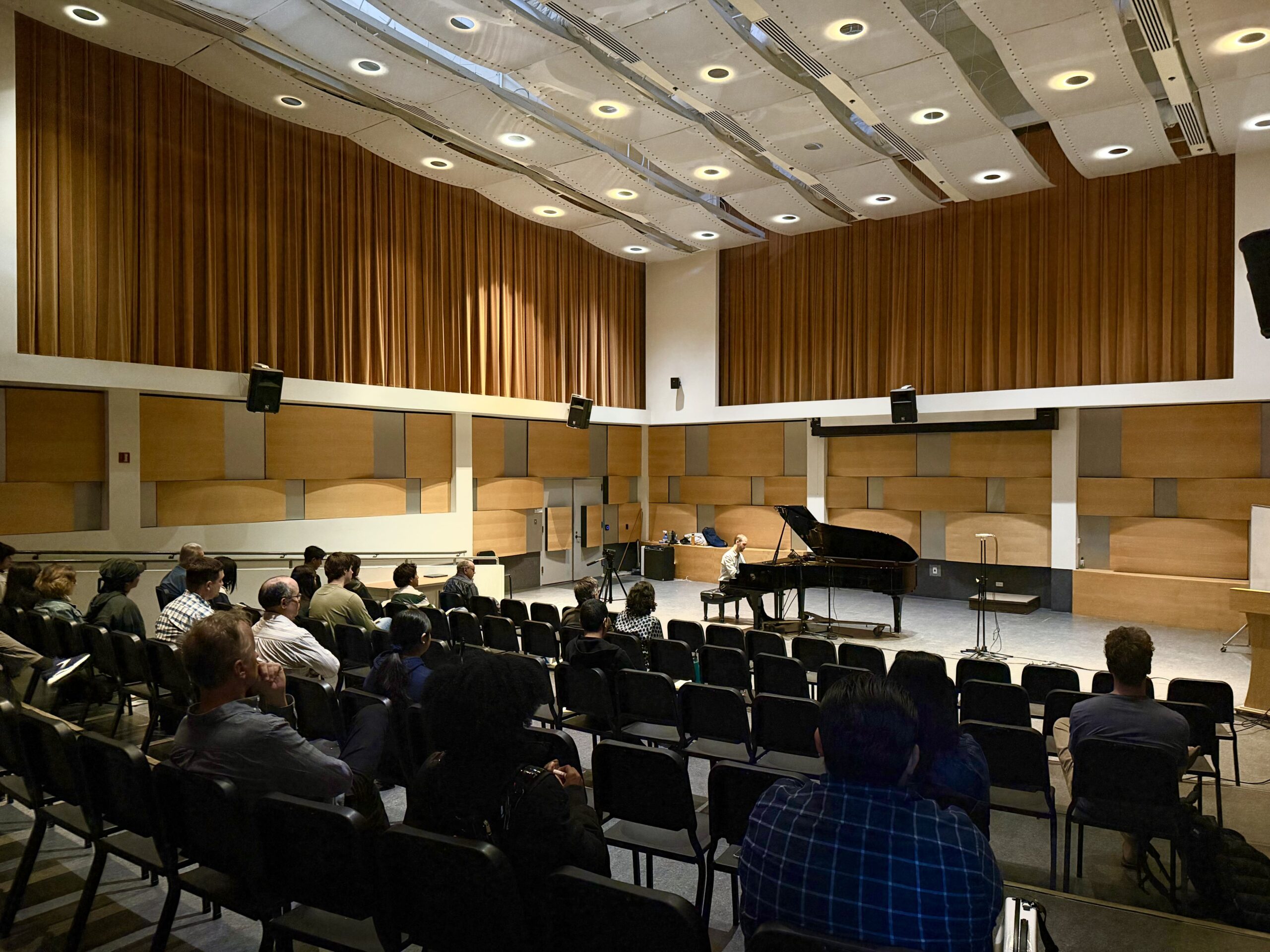
On Nov. 4, 2026, Dr. Todd Moellenberg, pianist and lecturer at the University of California, Riverside (UCR), performed in “Pioneers of Form: A Piano Recital” as part of the Florence Bayz Music Series. Moellenberg highlighted the attempts made by four composers, W. A. Mozart, Anton Webern, Bill Hopkins and Claude Debussy, in their effort to define and redefine the form of classical music.
In the selection of the repertoire, Moellenberg was particularly interested in how each of the composers were in conversation with one another to draw on the lineage they are situated on and show the progression. Starting off the performance with Piano Sonata in B-flat Major, K. 333 by Mozart, the sonata form of the First Viennese School was put on full display with emphasis on simplicity and balance. Allegro captured a sense of playfulness through the rhythmic and fast tempo tune. It was followed by Andante cantabile, moving in a much more calm and graceful manner. Then Moellenberg resumed with energy in Allegretto grazioso. All three pieces were consistent in their expressiveness and the melody that seems to flow naturally.
The second set was Variations For Piano, Op. 27 by Anton Webern, one of the pioneers of the Second Viennese School. This movement began in the aftermath of World War I, rejecting the old forms of the First Viennese School in response to the changing world. This artistic experimentation was made immediately apparent from the very first movement of the piece, Sehr mäßig. Unlike Mozart’s piece from the previous set, melody felt fragmented and notes seemed to be scattered all over the place, imbuing it with a sense of chaos. The oscillation between notes became more extreme in Sehr schnell, jumping between higher registers and lower registers drastically and spontaneously. The third movement, Ruhig fließend, had an eeriness and abrasiveness to it from how seemingly off it sounds.
This was followed by Études en série by Bill Hopkins. Coming from the post-Webern landscape of classical music, Hopkins had inherited much of the mechanisms from the Second Viennese School which he pushed to the extreme. Moellenberg sees “Webern as the minimalist of this new style and Hopkins as the maximalist.” Across (one) and (may), many of the elements in Webern’s pieces were present here as well, but with an almost atmospheric quality with a deeper layer in sound.
Moellenberg closed off the performance with Claude Debussy’s Images, Book I. The first movement, Reflets dans l’eau, established an ethereal ambience in the delicate fluidity of the sound while Hommage À Rameau carried a sense of solemnity beneath its exquisiteness. Mouvement, as the name suggests, exuded kinetic energy and volatility quite unlike any other pieces from the recital.
Many of the selected pieces, particularly ones by Webern and Hopkins, seemed to challenge the notion of classical music that many of the audience members would hold simply in how drastically different they were to the more familiar compositions. Moellenberg explained that “that’s my specialty as a performer. I got my doctorate in contemporary piano performance. Even as a kid I was always sort of a big fan of nonsense. I think a lot of my humor comes from nonsense, saying nonsensical things or absurdity, and I think I’ve increasingly gotten drawn to repertoire that can seem formless or nonsensical, and I like being able to make a form out of it.”
Through the deliberate juxtaposition of more “traditional” tunes of Mozart and Debussy with these works that push the boundaries of this art form, Moellenberg hopes to encourage the audience to recognize connection between the two. “Because I’m teaching all styles of repertoire, I like to think about how I can frame those pieces and maybe, just maybe, the audience might hear these interesting and unexpected connections with those pieces and things that maybe are a little bit more unfamiliar.”