On Oct. 15, industry professionals and University of California, Riverside (UCR) faculty and students met at the Highlander Union Building (HUB) room 302 for the Riverside Artificial Intelligence Research and Education Institute (RAISE) Summit. Panelists and attendees discussed potential implementations of artificial intelligence (AI) in education, specifically at UCR.
RAISE is a campus organization that involves researchers, educators and students which aims to “advance AI research, education and real-world applications.” It works to promote the application of AI and machine learning within education at UCR through research and collaboration.
Chancellor S. Jack Hu opened the summit by asking how the campus can “harness AI while preserving the critical thinking and human relationship that defines higher education.” He proceeded to discuss the opportunity that AI has to reshape teaching, research and university operations while noting the future depends on how individuals choose to develop and use AI – not on AI itself.
He added that UCR’s current role is to ensure AI advances academics and access while preparing students to lead in a world increasingly shaped by AI. “Our goal is not simply to understand and use AI.” Hu said in closing. “Our goal is to shape how AI will serve humanity.”
Among the speakers present at the summit was Google’s Chief Technologist Prabhakar Raghavan. He described Google’s research surrounding AI’s advancing capabilities including solving previously unsolvable equations, analyzing geospatial information and producing research at exponentially faster speeds.
Raghavan described the challenges these developments have created for human researchers, asking, “The research community, whatever field you’re in, is unable to digest and comprehend this … then what’s the point? What’s the incentive of producing them?”
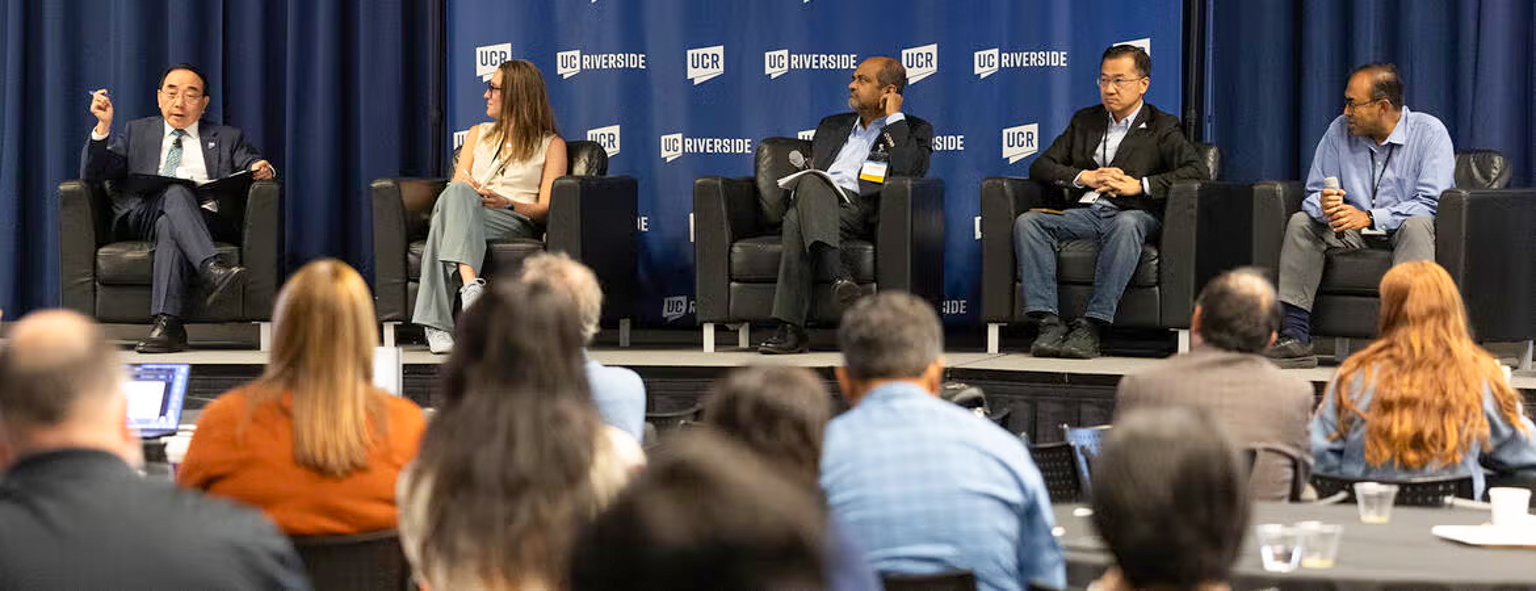
The summit then shifted to a “fireside chat” moderated by Chancellor Hu featuring UCR Professor of History Alejandra Dubcovsky and Professor of Electrical and Computer Engineering Amit Roy-Chowdhury, co-founder of the Foundation for Science and AI Research Chuck Ng and the University of Southern California’s (USC) interim dean of the Viterbi School of Engineering and director of the Stevens School of Computing and Artificial Intelligence Gaurav Sukhatme.
Dubcovsky emphasized the importance of thinking critically in the era of AI and challenged the notion that its adoption is inevitable, stating, “When we’re told that something is inevitable, the humanities teach us to ask, who is saying that? Who benefits from that inevitability?”
Roy-Chowdhury and Sukhatme advocated for students to work to further understand AI technology, with Gaurav proposing a mandatory AI general education course requirement for all students. Dubcovsky expressed support for this idea but also emphasized the importance of maintaining transparency with students regarding AI use, promoting “due diligence and ethicalness.”
Ng advocated for greater AI integration, proposing the development of an “AI innovation regional hub here in Southern California” and suggested that UCR could play a key role as a strategic leader, stating that, “We have more than what, 50% first generation, and the fastest part of California is here at Riverside, so I think there is a lot to offer.”
A later panel featured UCR professors including Associate Professor of Electrical and Computer Engineering Salman Asif, Associate Professor of Physics and Astronomy Simeon Bird, Associate Professor of Applied Mathematics Maziar Raissi and Associate Professor of Computer Science and Engineering Greg Ver Steeg.
They described how the presence of AI tools has dramatically altered the process of research within their departments, increasing the amount of papers which can be published. Ver Steeg and Asif described that with a greater volume of research being conducted with AI tools, higher importance is now placed on the quality of research questions themselves, with Ver Steeg stating, “That is something that successful students are all going to have to learn in the near, near, near future is deciding which of those things you really have to put that mental effort into.”
Bird reported that using AI to answer research questions allows him to ask his students the questions he thinks will be the most beneficial to their education, but in doing so risks separating students from the process of discovery — “They only do the things that are good for them. They don’t communicate so much in the wider work of the group.”
Chancellor Hu stated that UCR hosted the conference to start a discussion, declaring, “Everyone is aware that AI can be transformative. We are in an experimentation stage, so we want to hear from everyone, the speakers, panelists, where we are with AI, so get some awareness across campus.”