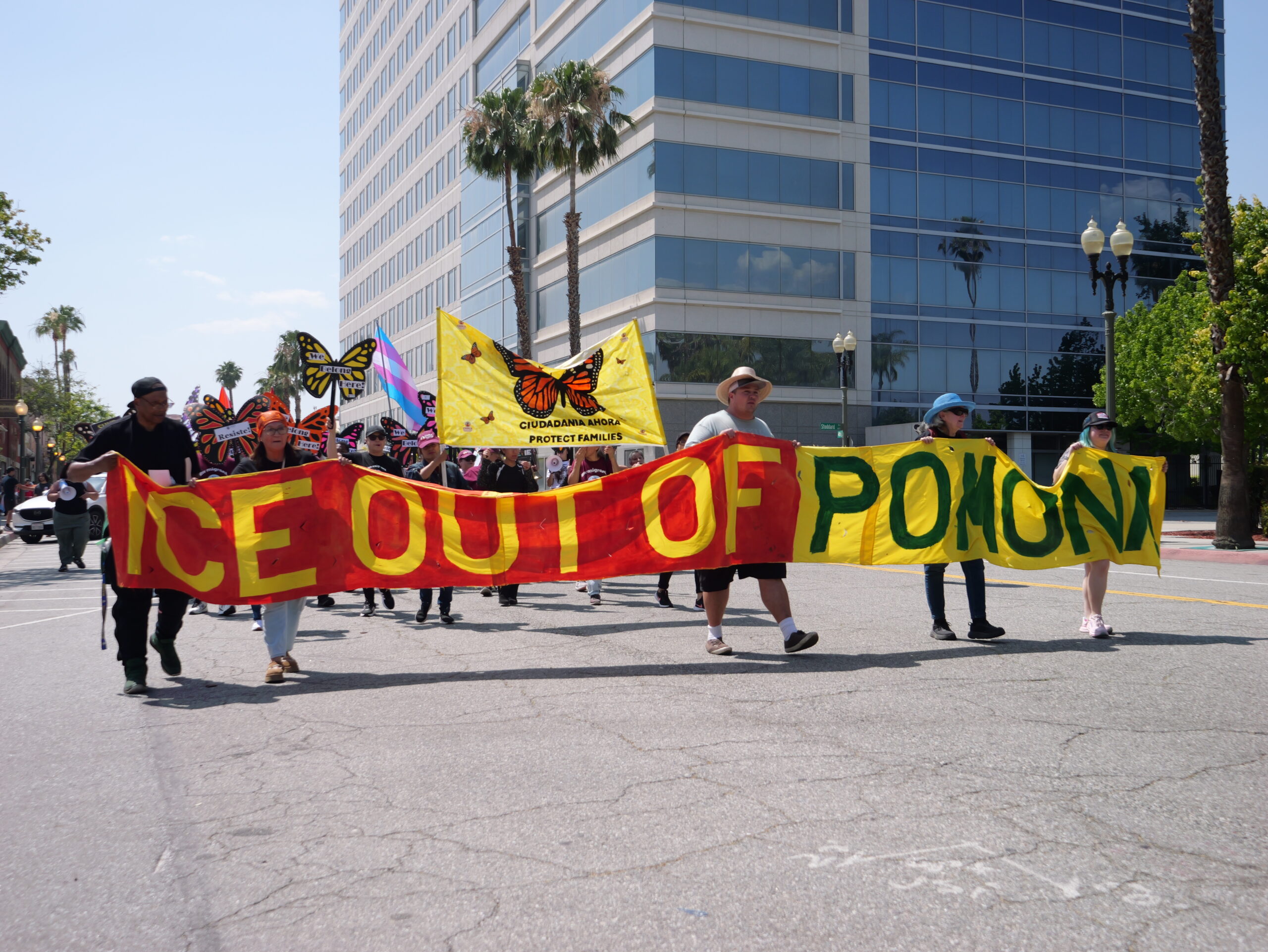
Voices echoed through the streets of downtown San Bernardino on May 1, 2026 as hundreds of Inland Empire (IE) residents took to the streets, marching past City Hall and the Department of Homeland security to demand an end to Immigration & Customs Enforcement (ICE) and better working conditions. Organized by the Inland Empire Labor Council (IELC), the May Day protest drew a broad coalition of labor unions and community groups — from Service Employees International Union (SEIU) and the Coalition for Humane Immigration Rights (CHIRLA) to Amazon Teamsters and the Pomona Day Labor center — uniting around worker protections, immigrant rights, rising costs of living and climate justice in a show of solidarity.
The demonstration was anchored by the IELC which represents over 90 unions and 400,000 members across the Riverside and San Bernardino counties. Executive Secretary-Treasurer Ricardo Cisneros noted that a key part of coordinating the May Day action was mobilizing that network into a unified turnout. Acknowledging the limits of a weekday protest due to working schedules, Cisneros emphasized that the responsibility now falls on those who attended to carry the message before the march, so that “next time around, this crowd can be much larger.”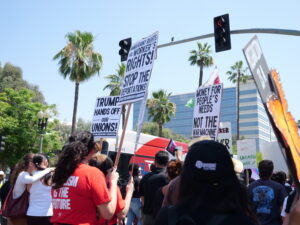
Standing before City Hall, Julian, a day laborer from San Bernardino, recounted being detained by ICE while looking for work — an experience that echoed one of the protest’s central concerns: that both immigrant and non-immigrant workers are increasingly forced to navigate their livelihoods under the threats of raids and workplace enforcement.
Julia Vega, a member of the Pomona Economic Opportunity Center who served as Julian’s translator, later emphasized that advocacy work like theirs is crucial amid widespread labor abuses across the IE. She pointed to the human cost of unsafe working environments, “leaving families torn apart. It’s leaving families without fathers, without husbands, without mothers.”
The march paused again outside the Department of Homeland Security (DHS) building in downtown San Bernardino, where Vincent Kraus — an Amazon employee and Teamsters member — addressed the crowd. He spoke to growing frustrations among warehouse workers and union members, accusing Amazon of allowing ICE agents to come into facilities and detain employees without warrants while continuing to profit from government contracts tied to immigration enforcement.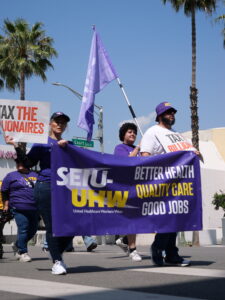
Sharing the importance of having unions like Amazon Teamsters to show solidarity at events like May Day, Kraus emphasized the shared stakes across movements. While political leaders often blame immigrants for economic hardships, he argued, “In reality, it’s the billionaires like my big boss, Jeff Bezos, who are making our lives worse.”
As the march reached its final stop at E Street and 4th, the crowd gathered around the final set of speakers. Will, a member of the Inland Empire Black Workers Center, drew a direct line between modern immigration enforcement and antebellum slave patrols, urging attendees to recognize what he described as a system of racial control and labor exploitation.
Quoting a letter James Baldwin wrote to an imprisoned Angela Davis in 1970, Will shared how a price had already been paid to bring into existence the American nation, but that “if we know and do nothing, we are worse than the murderers who hide in our name.” He called the crowd to action, exclaiming, “Let’s build the IE. The IE we deserve. One where there is no policing, no terrorization for work that kills us.”