
*Spoilers Ahead*
Season five of “The Boys” has somehow managed to make the world of supers even darker and more emotionally devastating than previous seasons. What started years ago as a violent satire of superhero culture has now transformed into a full-scale political apocalypse. For the most part, the show’s final season has delivered exactly the kind of chaotic endgame fans expected.
The biggest strength of the season so far has been its willingness to finally push characters to irreversible breaking points. Homelander is no longer pretending to be America’s hero. The season fully embraces his descent into authoritarianism, portraying him less as a celebrity superhero and more as a dictator with unchecked power.
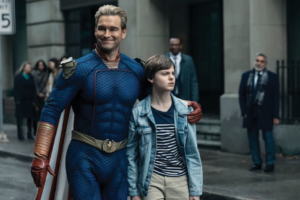
The show’s political commentary has always been blunt but season five removes whatever subtlety remained. Homelander dismantling government structures and surrounding himself with loyalists create some of the most disturbing moments the series has produced.
At the same time, the emotional core of the show remains the fractured relationships between the members of The Boys themselves. Billy Butcher continues to spiral deeper into obsession, while Hughie Campbell is forced to confront how hopeless their mission has become. The show has consistently excelled when balancing absurd violence with genuine emotional stakes, and season five contains arguably some of the strongest performances in the series.
The most shocking moment so far came in episode seven with the death of Frenchie, whose sacrifice instantly became one of the series most heartbreaking scenes. Frenchie and Kimiko have long served as the emotional center of the show, and his death finally gave the season the sense of consequences some viewers felt had been missing in previous years.
Not everything has worked perfectly, however. Some episodes still rely too heavily on shock value and gross out humor rather than meaningful storytelling. One criticism that has followed the show since season four is that it occasionally became the exact type of expressive spectacle it originally set out to parody. The main frustrations are with pacing and the overuse of increasingly graphic scenes, as well as its reliance in setting up Prime’s new show “Vought Rising,” a “The Boys” prequel.
Still, season five feels more focused than the previous season. The story finally feels like it is moving toward a definitive conclusion instead of endlessly resetting conflicts between Homelander and Butcher. The looming collapse of society gives the season urgency, and the inclusion of characters from “Gen V” helps the world feel larger without distracting too much from the central story.
One of the most impressive things about the season is how it refuses to offer easy optimism. Every victory comes with devastating losses, and nearly every character appears emotionally exhausted by constant violence. Even moments of humor now carry a layer of dread underneath them. That tonal balance is difficult to maintain, but creator Ric Kripke still manages to keep the show entertaining despite its increasingly bleak direction.
As for the finale prediction, it feels increasingly likely that Butcher will ultimately sacrifice himself to stop Homelander once and for all. The season has repeatedly hinted that Butcher’s hatred and obsession are destroying him physically and mentally, and his storyline feels destined for a tragic ending. Homelander may die, but the show seems more interested in exploring whether the systems that created him can ever truly disappear. Ryan will likely play a major role in ending, potentially becoming the deciding factor between repeating Homelander’s legacy or rejecting it entirely.
Verdict: If the finale succeeds, it probably will not end with a clean heroic victory. The most fitting ending for “The Boys” would be messy and very bittersweet. A majority of the protagonists will end up dead by the end of the show, which is exactly the kind of ending this brutal show deserves.