**Contains Spoilers**
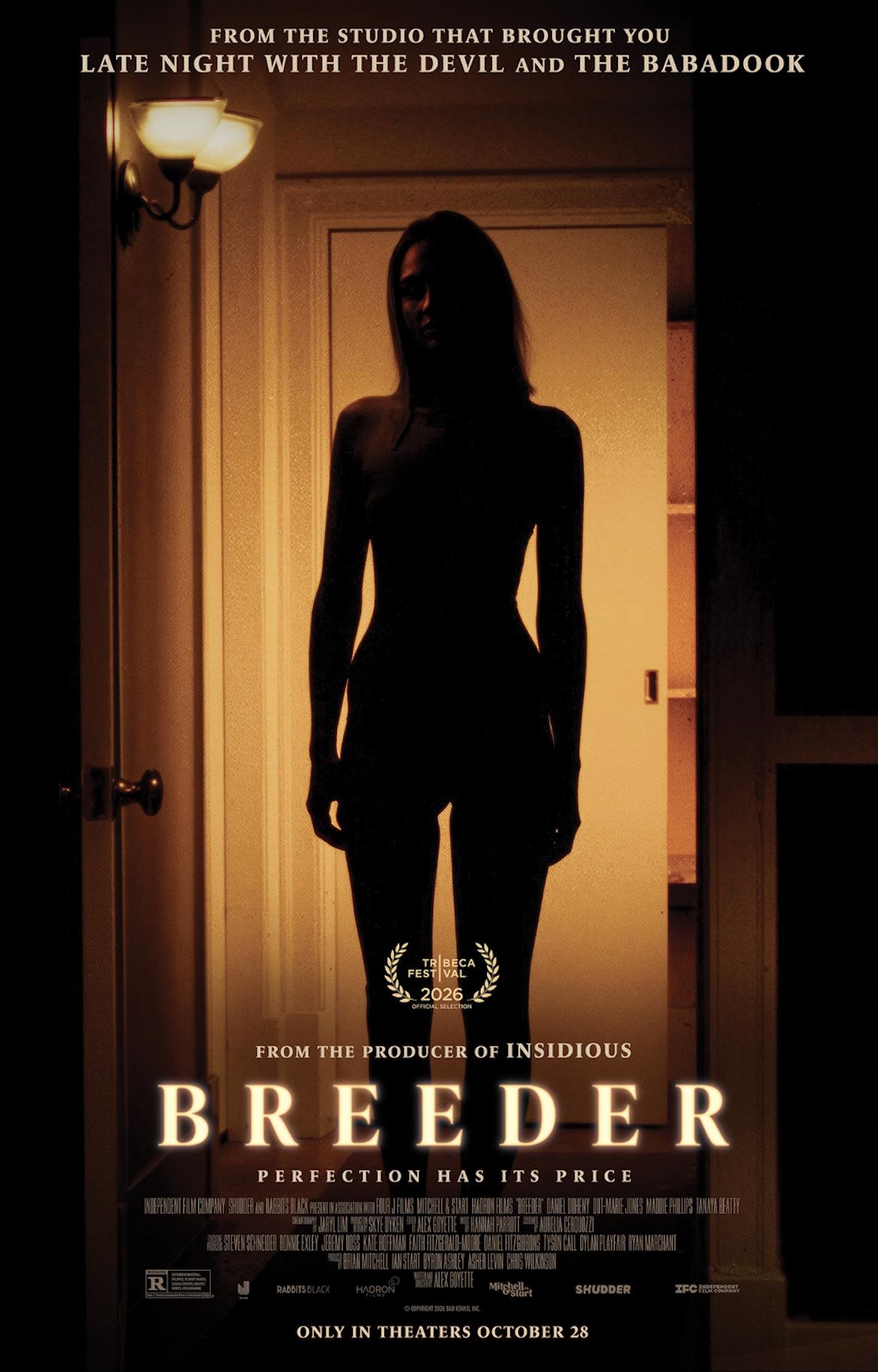
“Breeder” is Alex Goyette’s directorial debut. The film follows Russell (Daniel Doheny), a university student struggling to secure funding for his ambitious research project about bees. His luck is about to change when Patti, an award-winning poodle breeder, offers to fund his research. However, there’s a catch: Patti has a research proposition of her own.
The film does not live up to its potential, with unconvincing performances and a premise that is much more interesting than its execution. It is marketed and framed as something ‘out there,’ but “Breeder”barely manages to step outside the threshold. Its setup does much of the heavy lifting, carrying the film through an otherwise predictable storyline.
Some performances are so unconvincing that they manipulate the way audiences perceive a character, their role in the story and their relationships with others. The cast’s strongest performance is by Dot-Marie Jones who plays Patti, a poodle breeder who lives off the grid on a farm with her daughters. Patti is eccentric, unsettling and convinced that she is doing something for the greater good of society. Her ambition extends far beyond just breeding award-winning poodles. Now she wants to branch out into breeding only the most intelligent people.
It sounds like eugenics because it is. But Patti offers the question: Is that so wrong?
Patti offers Russell all the funding he needs, down to the penny, on the condition that he must become the “stud” for her latest venture. She intends to breed a child with an exceptionally high IQ by pairing Russell, whose IQ is supposedly 160, and one of her daughters, Ainsley, played by Maddie Philips, whom she selectively adopted for her high intelligence. What follows is an increasingly unnerving situation that should make for an unsettling and horrific descent into chaos.
Unfortunately, the film rarely capitalizes the absurdity of its own premise.
Cinematographer Jaryl Lim is responsible for one of “Breeder’s” strongest characteristics. Although the film does not necessarily deal with haunted-house style horrors, the visual style evokes a gothic horror aesthetic. The isolated farm, the shadowy, dimly-lit interior and unsettling visual language create an environment that feels sinister. The cinematography establishes a sense that something is not quite right, an atmosphere that the screenplay and most of the performances struggle to maintain.
There is a stark distinction between what “Breeder” suggests could happen and what actually happens. The anticipation is considerably more entertaining than the payoff. The premise begs for the film to embrace its own weirdness, but the logical problems in the screenplay make it difficult to take the film seriously. For a story about eugenics, human experimentation and the moral shortcomings of selective breeding, it is awfully tame.
Russell’s inconsistent characterisation leaves more questions asked than answered. He is supposedly selected for Patti’s experiment because of his exceptionally high IQ, yet he struggles to demonstrate much problem solving skills throughout the film. His decisions frequently contradict the intelligence the story wants you to know he possesses. Even more frustrating is his inability to take the relatively straight forward opportunities he is presented with.
His reluctance to cooperate initially suggests that he is holding onto some sense of morality, which could have made for an interesting internal conflict. However, the ending complicates that perspective. After almost a year of being controlled and held hostage by Patti, Russell seemingly makes no progress to escape and also abandons the reservations that drove much of his resistance to Patti’s program.
Russell spends most of the film navigating a situation he desperately wants no part in, only for the ending to undermine the reservations and everything he endured. The conclusion feels cheap and poorly justified. It becomes difficult to understand what the film wants the audience to take away from his character.
Despite its short runtime, “Breeder” manages to feel drawn out. The pacing struggles to maintain the momentum of its premise, and the narrative takes too long to reach a payoff that never arrives. The ending is the cherry on top of an underwhelming experience, leaving audiences with more questions about the film’s logic rather than the actual story.
There is something compelling buried within “Breeder.” Its premise is strange and horrifying, its cinematography establishes a dark and dangerous atmosphere, and Jones gives the film a memorable pillar performance. But potential can only carry a film so far. For a film about breeding the next generation of intellectuals, it could have used some more ambition and due diligence.
Verdict: Despite its sickening premise, “Breeder” is hindered by the inconsistent screenplay and performances, falling short of its potential.