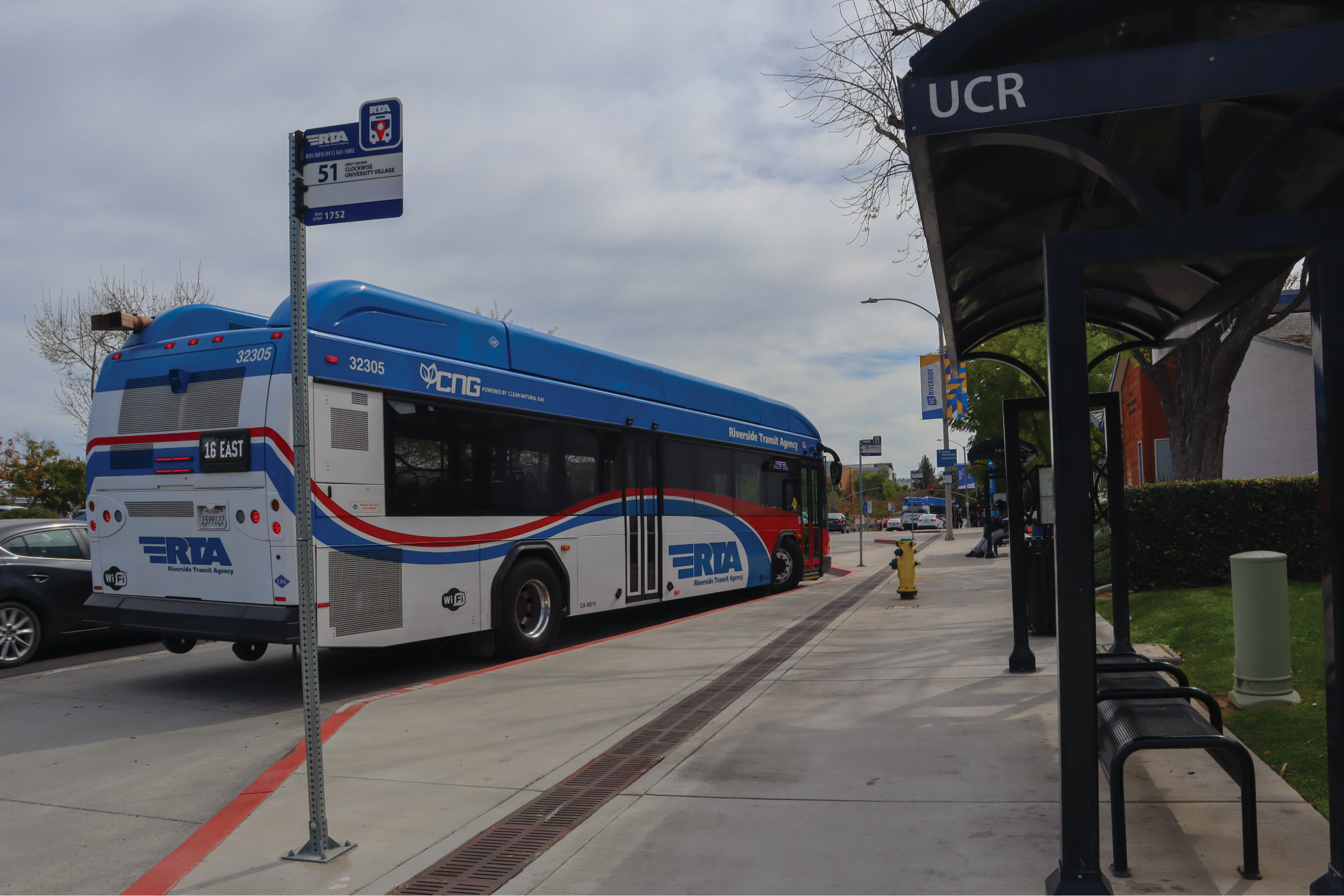
Riverside Transit Agency (RTA) is the main transit authority serving western Riverside County, including the University of California, Riverside (UCR). The transit authority is essential to the region, as many Riverside residents and students do not own a car or have access to other forms of transportation, making RTA the only viable option.
However, this leaves transit users vulnerable to the slow and often unreliable service RTA provides, forcing many to purchase cars or use Uber to commute — further contributing to air pollution in the region.
A major inadequacy of RTA’s service becomes apparent when it is compared with its peer systems. RTA receives similar levels of funding while serving comparable populations or geographic areas, but still experiences service issues in bus schedules and frequency of bus routes.
One peer system to RTA is Omnitrans, which serves the City of Riverside and is the main transit system for San Bernardino County. Omnitrans offers rides for a fare of $2.00 per ride, compared to RTA’s $1.75 per ride for local buses and $3.50 for commuter express buses. Compared to RTA’s proposed $93.2 million for the 2023 fiscal year, Omnitrans received an operating budget of $118.5 million.
While RTA offers a cheaper ride, the bus schedules are often far worse. When comparing the highway buses, Omnitrans Route 215, which connects San Bernardino to Downtown Riverside, comes every 30 minutes during off-peak travel times and every 20 minutes during peak travel times from 5 a.m. to 10 p.m. on weekdays. Meanwhile, RTA has Route 200 covering San Bernardino, Downtown Riverside and Orange County, with the route terminating at Disneyland. However, since this route covers so much ground, it stretches RTA’s allocated buses, leading to headways of roughly an hour or more.
These two bus routes are based on drastically different ideas of transit planning: coverage and frequency. RTA’s planning skews towards coverage because, rather than adding frequency and express options to popular lines like Route 1, RTA allocates drivers and buses to routes that cover vast swathes of Riverside County with lower frequency. This means that the population it’s intended to cover is “served” by the metric of coverage instead of usability. In contrast, Omnitrans offers frequency with the sbX Bus Rapid Transit (BRT) service, providing reliability and more frequent rides.
This is not to say that coverage is bad per se for public transportation. But if transit agencies plan public transportation too far towards coverage, the service as a whole suffers. Although someone could theoretically go somewhere via public transit, if it takes drastically longer than a car, few people will, except those who are transit-dependent and are forced to.
The fix for this dilemma would be to rethink how RTA serves western Riverside County, and specifically, whether people value coverage or frequency more. To make these changes, RTA should evaluate travel data and hold discussions with transit users. Using this data, RTA could better plan its routes and reconsider ending certain stops to speed up buses. They could also reintroduce RTA’s RapidLink, which was a BRT similar to LA Metro Rapid, or simply buy more buses to expand service while keeping coverage as is.
Many may argue that changing public transit systems is costly. Building something similar to Omnitrans sbX would be expensive, as the entire project costs $192 million. However, RTA does not need to have the same degree of infrastructure to improve its bus services. RTA could implement small, cheaper changes by adding more drivers to run more buses on existing routes, adopting signal priority at traffic lights so buses have green lights instead of constantly having to wait at red lights or consolidating stops to speed up bus routes.
Another argument often raised against a bus network redesign that favors frequency is the reduction in coverage, such as decreasing the number of bus lines in an area or needing to walk further to the nearest bus stop once changes are implemented. This could become an issue for riders and should be a consideration in deciding what changes should be added for route speed or frequency.
Research and data collection of transit users’ preferences will need to be conducted to determine what changes will be in the best interest of the system as a whole. That can include better documentation of the locations where people live and work to optimize where buses travel or asking for riders’ suggestions on what should be done to improve the current system. However, keeping the system as it is will serve the needs of Riverside residents and students.
The way RTA is serving western Riverside County is inadequate because it leans too far toward coverage instead of frequency. It’s time to reform it to the needs of the Riverside community and balance RTA’s transit planning priorities so everyone has a better and more seamless experience on public transit.