
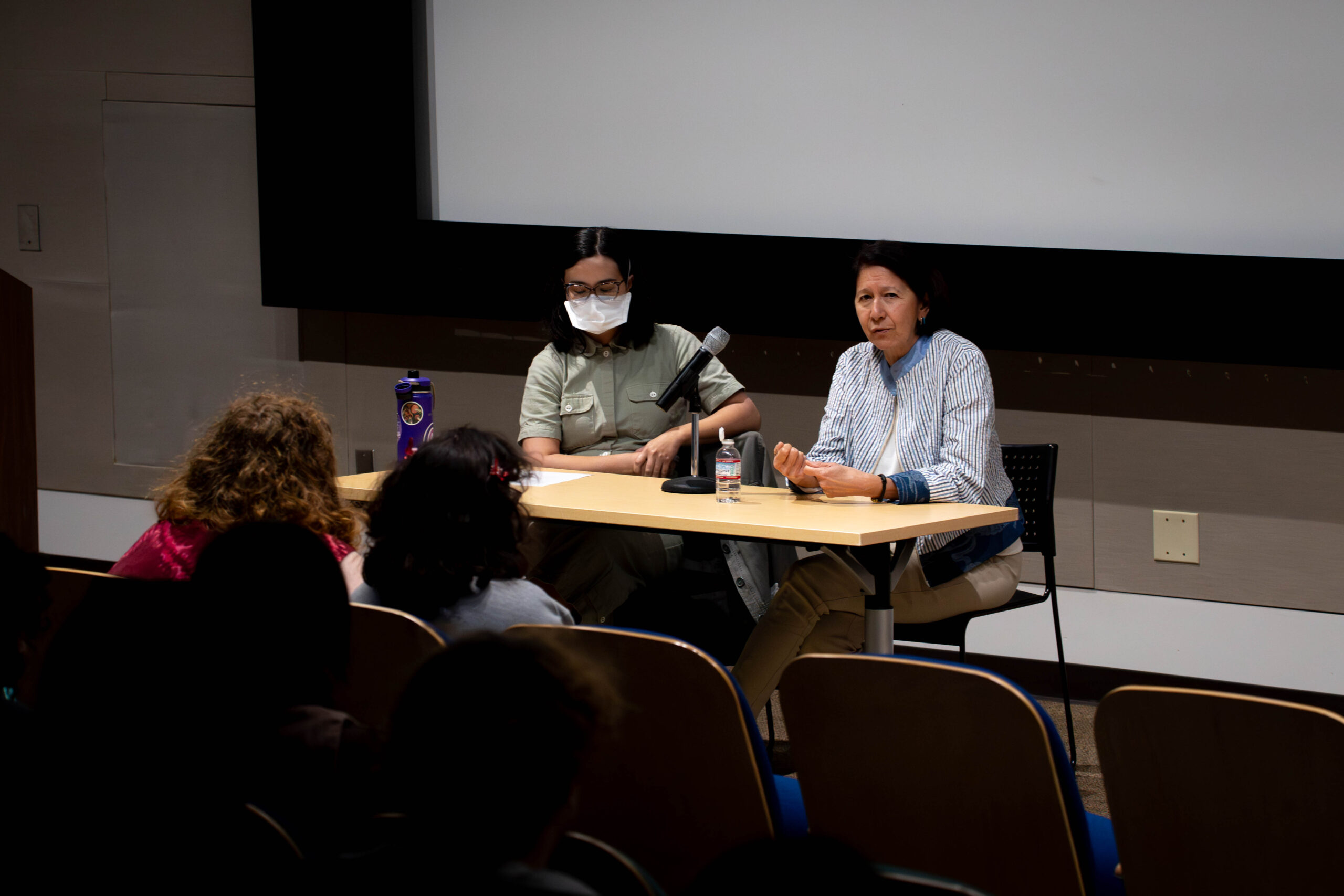
On April 22, 2026, the Department of Theater, Film and Digital Production at the University of California, Riverside (UCR) hosted the screening of two documentaries directed by Jeniffer Lin, “Ten Times Better” and “About Face.” Together, these documentaries examine the eurocentric traditions of ballet that often go unchallenged, offering a contemporary lens on racial representation within the medium.
“Ten Times Better” tells the story of George Lee, an Asian American ballet dancer and the hardships he’s faced due to his ethnic background. Born in Hong Kong, Lee encountered ballet through his mother, who is of Polish descent. He would take dance classes and perform at Russian clubs for rice.
Due to the Chinese Civil War, Lee and his mother had to move to Shanghai, then later to the Philippines and ultimately ended up in the United States. Lee enrolled in the School of American Ballet and was picked up by highly influential ballet choreographer George Balanchine to originate the role of Tea in “The Nutcracker,” which is considered an orientalist caricature. Lee would be put in makeup to make him appear stereotypically Asian for the role.
Lee had hoped for a New York City Ballet membership but was declined due to his “height.” He moved to Broadway due to ballet’s exclusivity toward people of color, being cast in “Flower Drum Song” among numerous others. However, this didn’t last either as he struggled to get roles and was simply told he wasn’t the “type.” Lee was growing old and ultimately settled in Las Vegas as a poker dealer.
The title of the film, “Ten Times Better,” which comes from Lee’s mother’s word to Lee that he has to be “ten times better” to compete against white dancers, perfectly captures the struggle of adversity Lee was faced with simply on the basis of his ethnicity despite his talent.
“About Face” shifts focus from an individual story to a broader scale, following ballerina Georgina Pazcoguin and choreographer Phil Chan’s effort to foster an environment in ballet where racially offensive practices that are prominent even in some canonical works such as “The Nutcracker” and “La Bayadère” to be examined more critically. Rather than “cancelling” these works, Pazcoguin and Chan seek to provide a way of continuing them while maintaining cultural integrity.
They’ve actively taken actions against practices rooted in anti-Asian sentiment that reinforces harmful stereotypes such as yellowface makeup by starting a petition against it which multitudes of major ballet companies signed. Similarly, Chan’s reiteration of “La Bayadère” combats the cultural appropriation that was present by removing them through reinterpretation of the work.
The documentary also revolves around the idea of ballet as a changing art form adapting to the changing society as while it was initially performed for European monarchs, that is no longer the case and cannot ignore non-western representations for its own relevancy.
The audience were highly engaged with the documentaries, with massive applause at the end of each film and some even shedding tears following George Lee’s story.
After the screenings, a Q&A session was held with Jenifer Lin. During the Q&A, Lin shared that she was initially introduced to Phil Chan’s book “Final Bow for Yellowface” through her daughter in 2020. The book struck a chord with her as she loved ballet as a kid, but felt uneasy about “The Nutcracker” in its portrayal of Asian culture given that her father was Chinese. With an increasing amount of hate crime against Asian people during the pandemic era, Lin felt that it was the right time to make a project about exclusions and misrepresentation of Asians in ballet and approached Phil Chan and Georgina Pazcoguin.
During their conversation, Phil advised Lin to look into the New York Public Library and their archives on the original George Balachine iteration of “The Nutcracker.” Through that, Lin had first learned about George Lee and was intrigued as despite working with Balachine, Lee didn’t seem to have much other work in ballet. Using her journalistic background Lin got in contact with Lee and when she heard the story, she knew this had to be her next project.
Lin feels that these are stories that are relevant in a timely manner and had to be told now as she asserts, “[Diversity, equity and inclusion] has become a radioactive phrase in some corners. I think the issues of diversity, equity and inclusion representation on the stage are still very important and I feel as if what I’m trying to do here is to continue the conversation in a thoughtful and nuanced way.”