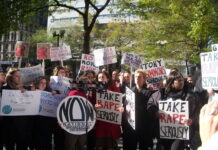
If you’ve walked around the University of California, Riverside (UCR) campus in recent months, you’ve likely encountered petitioners holding clipboards and asking whether you are registered to vote and over the age of 18. With tables near the Bell Tower, the Highlander Union Building, Market at Glen Mor and the residence halls, these petitioners often display signs reading “End ICE!” or “Stop Climate Change!” while offering free Celsius drinks and chips to students who sign.
The increased presence of petitioners comes ahead of the 2026 midterm elections. In California, the deadline to submit initiative signatures is June 25, 2026, as county elections officials must verify all signatures 131 days before the election. Although UCR is a public university, petitioners have largely operated without regulation by the university administration or the UC Police Department (UCPD) even as they petition near dormitories, commuter parking lots and inside the Tomás Rivera and Orbach Science Libraries.
The Editorial Board investigated who employs these petitioners, how they are paid, the nature of the petitions they ask students to sign, how they present the information to students and how UCPD enforces campus policies regarding outside tabling.
Based on conversations with petitioners and UCPD, The Highlander found that the petitioners are hired by private contractors and are typically paid between $5 and $10 per signature — meaning they can earn hundreds of dollars from just 50 student signatures. When asked about their employers, petitioners often avoid answering directly or refer students to the California Secretary of State’s “Initiatives and Referenda Cleared for Circulation” website.
It is important to make clear that these individuals are not volunteers. They are paid workers gathering signatures to qualify specific initiatives that their employers want on the state ballot. This may be unclear to many UCR students, who may not realize that private companies can fund petition drives for their own political goals.

Since petitioners work for different contractors, they are effectively competing against each other to collect as many signatures as possible. This leads to pressure tactics, including saying “I’ve been out here all day” or “I won’t be here tomorrow,” and using emotionally and politically charged terms on signs to attract students who care about these broader social issues.
Most petitioners ask students to sign multiple petitions — roughly 10 petitions — organized on a single clipboard, with each having a summary at the top of the page. However, when asked for more details about the initiatives, petitioners usually cannot provide more information and instead direct students to the Secretary of State’s website. The Editorial Board compared the messaging on petitioners’ signs with the official state analyses and found significant discrepancies.
For example, many petitioners use “End ICE” to draw student attention. They are referring to the measure, The People’s Right to Choose Their Attorney Act, which would prohibit the state from denying or interfering with “the right of any person to contract with an attorney of their choice to protect or vindicate their legal rights.” The initiative focuses on the “middle class Californians and their families” who cannot afford “retainers and hourly fees that large corporations pay for their attorneys.”
This is not to say that this proposal is a good or bad policy. The issue is that framing it as a measure to “End ICE” is misleading. Students will sign the petition under the impression that it explicitly says it will eliminate federal immigration enforcement when it in fact does not.
However, what is most concerning is the lack of consistent enforcement from UCR administration. According to UCPD, petitioners are only allowed to table on campus at the Bell Tower and cannot sell anything without prior approval. UCPD will only respond to specific tables that are reported or called in, meaning enforcement is complaint-driven.
There are several issues with this policy. First, if multiple petitioners are operating outside the Bell Tower, UCPD will only go to those specifically reported and leave the others alone. With dozens of tables spread around campus, it is unrealistic to expect students to report each one individually.
Second, even when UCPD does enforce the policy, it is temporary. Petitioners can move and resume petitioning elsewhere on campus in less than an hour, bypassing the policy again.
Finally, not all students feel comfortable contacting UCPD. Petitioners frequently target first- and second-year students, who may be unfamiliar with campus policies or hesitant to report them. Enforcement is inconsistent, allowing petitioners to continue unchecked.
The lack of response from UCR is also deeply hypocritical. UCPD will take action against fruit vendors near campus, despite the fact that students want to support their business and buy their goods. Yet petitioners employed by private contractors who earn money from misleading and pressuring students are allowed to operate with less oversight. As a Hispanic-Serving Institution, the university should reconsider its priorities.
Ultimately, without UCR’s enforcement, it is up to students to protect themselves. If you choose to sign, research the initiatives and ask questions — including who the petitioners work for. If you feel uncomfortable, contact UCPD. Be careful about sharing your personal information, as they ask for your full name and address. If you want to learn more about these issues, consider getting involved with campus clubs and organizations that advocate for them in the UCR and Riverside community. Above all, protect yourself.